

For many people who think of Florida’s nickname as the Sunshine State, they often imagine of sun kissed beaches and idyllic days by the water. But the state’s average of over 200 days of sun per year also make it an ideal location for all things solar powered!
Now, with a nickname like the Sunshine State, you might think that Florida has both feet well and truly planted in the use of solar power. But that is not always the case. Although more and more people are interested in embracing solar power, the practice of harvesting Florida’s seemingly endless sun is not widespread.

So when, in July 1990, a fleet of solar powered vehicles embarked on a strange and electrifying race, it turned heads all the way along the route from Florida to Michigan. Known as the GM Sunrayce USA, 32 teams of college students had spent the previous year and a half building a variety of vehicles designed to run entirely off of solar power before hitting the road from Orlando’s Epcot Center. Those that competed included:
- Arizona State University – Tempe, Arizona
- Auburn University – Auburn, Alabama
- California State Polytechnic University – Pomona, California
- California State Polytechnic University – San Luis Obispo, California
- California State University – Los Angeles, California
- California State University – Northridge, California
- Clarkson University – Potsdam, New York
- Colorado State University – Fort Collins, Colorado
- Crowder College – Neosho, Missouri
- Dartmouth College – Hanover, New Hampshire
- Drexel University – Philadelphia, Pennsylvania
- Florida Institute of Technology – Melbourne, Florida
- Iowa State University – Ames, Iowa
- Mankato State University – Mankato, Minnesota
- Massachusetts Institute of Technology – Cambridge, Massachusetts
- Rochester Institute of Technology – Rochester, New York
- Rose-Hulman Institute of Technology – Terre Haute, Indiana
- Stanford University – Stanford, California
- Stark Technical College – Canton, Ohio
- The University of Texas – Austin, Texas
- University of Maryland – College Park, Maryland
- University of Michigan – Ann Arbor, Michigan
- University of North Texas – Denton, Texas
- University of Ottawa – Ottawa, Ontario, Canada
- University of Pennsylvania – Philadelphia, Pennsylvania
- University of Puerto Rico – Mayaquez, Puerto Rico
- University of Waterloo – Waterloo, Ontario, Canada
- Villanova University – Villanova, Pennsylvania
- Virginia Polytechnic University – Blacksburg, Virginia
- Western Michigan U and Jordan – Kalamazoo, Michigan
- Western Washington University – Bellingham, Washington
- Worcester Polytechnic Institute – Worcester, Massachusetts
Although the design guidelines primarily required the cars to be solar powered and fit within maximum size parameters (6m (19.7ft) in length, 2m (6.6ft) in width, and 1.6m (5.25ft) in height), the race itself had several regulations that all teams were required to follow. First, all cars were inspected and tested prior to the race beginning. Second, given that the average race day would cover more than 160 miles, all teams were required to make a mandatory pitstop at a designated daily halfway point.
Covering more than 1,600 miles over the course of 11 race days, the 32 collegiate teams traveled from Orlando, Florida all the way to Warren, Michigan. With names like “Sunshine Special” and “Sunrunner,” the teams made up of university students provided great inspiration to residents and visitors alike along the entire route.
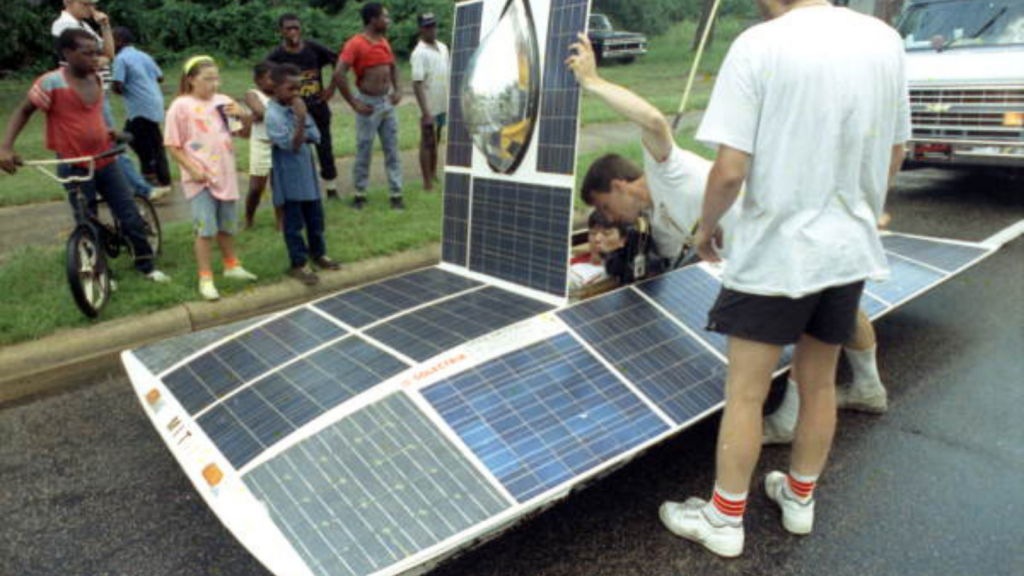
Although primarily sponsored by GM, the race was also co-sponsored and promoted by Chevrolet, the Department of Energy, and the Society of Automotive Engineers. As such, the co-sponsors set aside a list of goals that they hoped could be achieved with this cross-country challenge. In particular, the Department of Energy hoped to educate and inspire in the following ways:
- Further the educational skills and opportunities of student scientists and engineers
- Stimulate the applications of conservation and renewable energy technology
- Generate interest in the general population for alternative vehicle technology
- Generate interest in science and engineering
Achieving all of that and much more, the race drew the attention of thousands of residents and students along the entire route as well as through a number of media outlets across the country.
Also known as the American Solar Challenge, the Sunrayce marked the start of organized solar car “raycing” in the United States. Born out of the 1987 victory of GM’s Sunryacer solar car in the first World Solar Challenge in Australia, GM leadership was inspired to create their own collegiate event. The “rayce” went on for years afterward, taking place in 1993, 1995, 1997, and 1999. Beginning in Orlando in 1990, the race returned to the Sunshine State in 1999 as the route took racers from Washington, D.C. back to Orlando as it closed out GM’s sponsorship of the event.
From then on, with a change in sponsorship, the aptly renamed American Solar Challenge (ASC) continued in 2001 with a new format, including race stages which lasted multiple days, higher mileage races, and no rest days.
Continuing to take place every two years, the GM Sunrayce USA and American Solar Challenge have crisscrossed the United States time and time again.
- 1990: Orlando, Florida – Warren, Michigan (GM Sunrayce USA)
- 1993: Arlington, Texas – Minneapolis, Minnesota (Sunrayce 93)
- 1995: Indianapolis, Indiana – Golden, Colorado (Sunrayce 95)
- 1997: Indianapolis, Indiana – Colorado Springs, Colorado (Sunrayce 97)
- 1999: Washington, D.C. – Orlando, Florida (Sunrayce 99)
- 2001: Chicago, Illinois – Claremont, California (American Solar Challenge 2001)
- 2003: Chicago, Illinois – Claremont, California (American Solar Challenge 2003)
- 2005: Austin, Texas – Calgary, Alberta, Canada (North American Solar Challenge 2005)
- 2008: Plano, Texas – Calgary, Alberta, Canada (North American Solar Challenge 2008)
- 2010: Broken Arrow, Oklahoma – Naperville, Illinois (American Solar Challenge 2010)
- 2012: Rochester, New York – St. Paul, Minnesota (American Solar Challenge 2012)
- 2014: Austin, Texas – Minneapolis, Minnesota (American Solar Challenge 2014)
- 2016: Brecksville, Ohio – Hot Springs, South Dakota (American Solar Challenge 2016)
- 2018: Omaha, Nebraska – Bend, Oregon (American Solar Challenge 2018)
- 2021: Independence, Missouri – Santa Fe, New Mexico (American Solar Challenge 2021)
Activity
Discover your state’s nickname and its origin story. Brainstorm 2 or 3 different nicknames that your state could have based on its industry, environment, history, and people. (And feel free to give the reasons for your recommendations!)
To help you brainstorm, consider some of the following questions:
- Is your state known for a particular historical event?
- Is your state famous for its environment or for a rare plant/animal?
- Does your state have a traditional industry that has shaped its reputation over the years?
For instance: Recently, some residents of Florida have begun to question the state’s nickname. Rather than the Sunshine State, they recommend that Florida, instead, become known as the Water State. Their reasoning centers on the abundance of water in Florida’s tourism and fishing industries, the state’s position as a peninsula which is bordered by water on three sides, and on their belief that other states are more deserving of the Sunshine State honor.
Did you try this activity? What are some of the nickname ideas that you came up with for your state? Share your activity results with us on social media by tagging History Becomes You and by using #historybecomesyou !
Check back next Thursday for the next of many peeks into history!
 History Becomes You
I enjoyed reading about the American Solar Challege. Wish I could be at the start of this year’s race in July in Independence, MO. Maybe they would offer rides in the cars! Probably not. Anyone else sure we would all be driving Jetsons’ cars by now? Anyone else think we Floridans would all be benefitting from affordable, prolific solar energy by now? Re: alternates for Florida’s nickname…my cynical list includes: The Overdeveloped State, The Traffic Jam State, The Alligator State, The Sand is Everwhere State, The Please Go Back to Your Own State State,, The Sweaty State. I could go on. Serious nicknames are more difficult to come up with. I get the Water State idea, but it just doesn’t have the same ring to it as The Sunshine State. I say we stick with that and maybe the people who are advocating changing it can put their energy into protecting our waters.
LikeLike
I, for one, would be happy to be the Alligator or Manatee State due to my love of our native species – especially if it led to more protection of their populations and habitats. I am also a big fan of the Mangrove State, but, having grown up in Florida, I can also say that the Sand is Everywhere State is a pretty apt description of my childhood at the beach or playground.
LikeLike