


April 1949
Just before noon on April 13, 1949, a magnitude 7.1 earthquake rocked western Washington state. Still regarded as the one of the most powerful earthquakes to shake the Puget Sound region, this rattler left largescale chaos and destruction in its wake. From homes to businesses and everything in between, the damage from this earthquake was deeply felt and documented throughout the region.
And, although the shaking lasted for only 30 seconds, it was felt over an area of 230,000 square miles (including all of Washington state, northwest Oregon, southwest British Columbia, the northern Idaho panhandle, and into northwest Montana). While most of the damage occurred between Seattle and Chehalis, historic preservationists sprung to action to save the iconic Washington Legislative Building in the Capitol Complex.
1922
After years of fights and funding disputes, work began on one of the most recognizable buildings in Washington – the state’s Legislative Building. Based around the intriguing and creative idea of constructing a complex of structures rather than a single sprawling capitol building, the state’s Capitol Complex began to take shape through a plan for roughly six buildings – all interrelated and cohesively planned – as well as carefully curated landscaping and decoration.
And, although the growing population of Washington might not have expected the dominance of these Graeco-Roman structures, their classical design drew eyes and attention from miles around. As the centerpiece and largest of the five buildings, the massive Legislative Building and its towering dome stood apart as an example of groundbreaking achievement in both design and construction.
In the case of the dome, its construction posed questions from the very beginning. Requiring a massive reinforced concrete mat (measuring 130 square feet) and four huge concrete pillars (each 19 square feet) as just the footing for the dome gave construction teams and engineers pause. From logistical issues such as having enough cement to allow for a continuous pour all the way to being able to build forms strong enough to hold the vast amount of concrete while it set, teams even had to contend with how they could get the concrete high enough to pour at all on the upper levels.
Brick and stone work proved a complex process as well. Although it is not readily evident, the walls of the Legislative Building are made out of brick and covered by sandstone or marble – a design that was carried all the way through the building and up onto the dome.
But, even more impressive is the fact that the construction of the dome actually involved the creation of multiple domes and cones. While the outer dome was made of brick covered with cut stones, the inner dome (also made of brick) was finished with plaster on the interior face. But, unseen and unknown to many outside of the building teams, between the two a steel cone was constructed to support the concrete slab which held the lantern. Even more interesting was the use of greased led between the outer dome and the lantern’s slab to allow the outer dome to expand or contract without affecting the lantern.
1928
Stepping back from the completed Legislative Building after its six-year construction, many throughout the state stood in wonder at the beauty of the architecture and craftsmanship. From the elegant colonnades to the massive bronze doors complete with bas-reliefs of the state’s industrial heritage and early government structures, the Legislative Building appeared a capitol fit for a burgeoning state and determined people.
But not everyone was so pleased…
One man, in particular…
Governor Roland Hartley was greatly distressed by the cost of the Legislative Building. As a Republican running for office in the same year, he, instead, saw the Legislative Building as an example of unnecessary opulence. During his statement at its completion in 1928, he described the building as “a monument to extravagance” and as a “criminal waste of public funds” – hardly the expected remarks of the state’s governor.
Nonetheless, Hartley decided to make the Legislative Building a major political issue in his 1928 election campaign. Taking a brass spittoon from the Legislative Building and attaching it to the roof of his car (an act of theft that few people seemed to notice or grasp), he travelled throughout the state criticizing the building as a large expenditure of public funds. He came to call the Legislative Building the “golden spit box” and the pilfered spittoon became his symbol for waste. The issue became so ingrained in his campaign that his team was even dubbed the “Cuspidor Caravan.”
However, despite Hartley’s re-election, historians have revisited the 1928 campaign for further study. As it turns out, 1928 was a Republican year. So, some historians argue that Hartley simply ran behind the rest of the ticket. And, although we can be sure he would disagree, it would seem that his “golden spit-box” smear campaign actually had little to do with his re-election. Nonetheless, his would not be the last attempt made by politicians and other powerful individuals to take up arms (or spittoons) in an attempt to shame architecture or historic preservation over the consideration of money – thankfully it would not be an argument just two decades later.
April 1949
For 30 seconds, the Legislative Building shook, the 5-ton chandelier hanging in the rotunda swayed, and the stone around the dome began to crack under the strain.
In 30 seconds, the Legislative Building – an iconic structure just celebrating its 21st birthday – stood cracked, broken, and in desperate need of help as people spread out over thousands of miles struggled back to their feet and took stock of the damage around them.

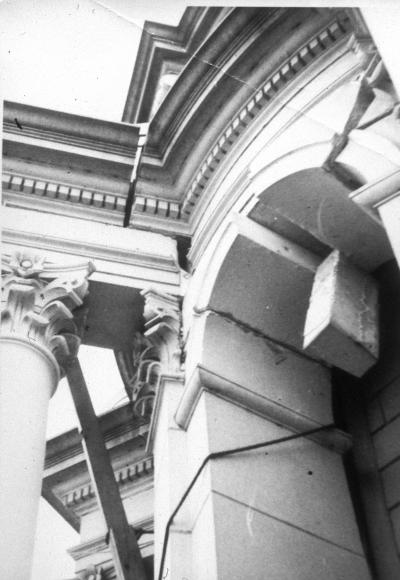

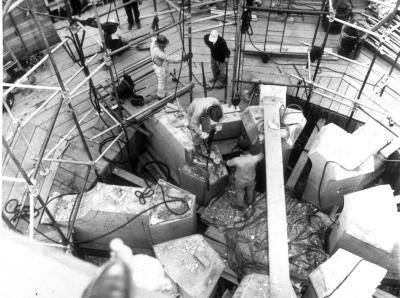
Yet, as communities sprang to action to clean up the debris and help their neighbors, preservationists turned their eyes to the Legislative Building.
Not only would the stone lantern at the top of the dome need to be repaired, but some of the columns had shifted and there were large cracks in the structure.
But how could teams begin the process of repairs? The dome was hardly what one would call accessible, particularly given the heavy stone materials needing repair and the ability to move through the building safely after the earthquake.
The solution?
The team built an incline railroad right up the side of the dome. Creative or crazy, no one could say at the time, but their boldness paid off and repairs went ahead.
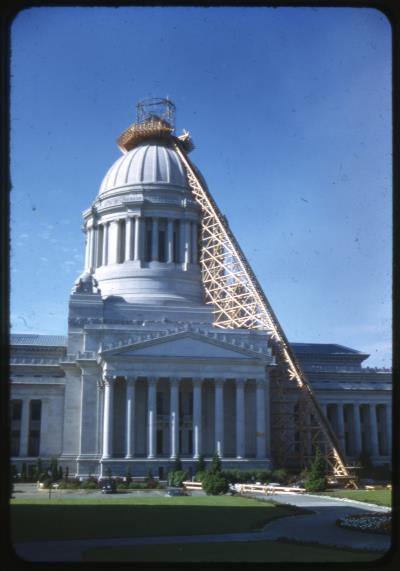
Meanwhile teams worked to shore up cracks in stone features and realign columns to restore the building back to its spittoon-worth glory.
All-in-all, the preservation teams restored the 30,800,000 pound dome and the building itself – retaining the architectural beauty that continues to make it a standout among capitols throughout the country.
1979
There remain few great domes in the western United States so it came as no surprise that such a stunning architectural and historical feature of Washington state would be significant enough for historical designation. Listed on the National Register of Historic Places in 1979, the Capitol Complex historic district continues to stand apart from other government sites in so many ways. From its cohesion and architectural beauty to the community’s dedication to preserving its iconic architecture despite earthquake after earthquake, the Legislative Building remains a pivotal and eye-catching part of the district – the icing on top of the dome if you will.
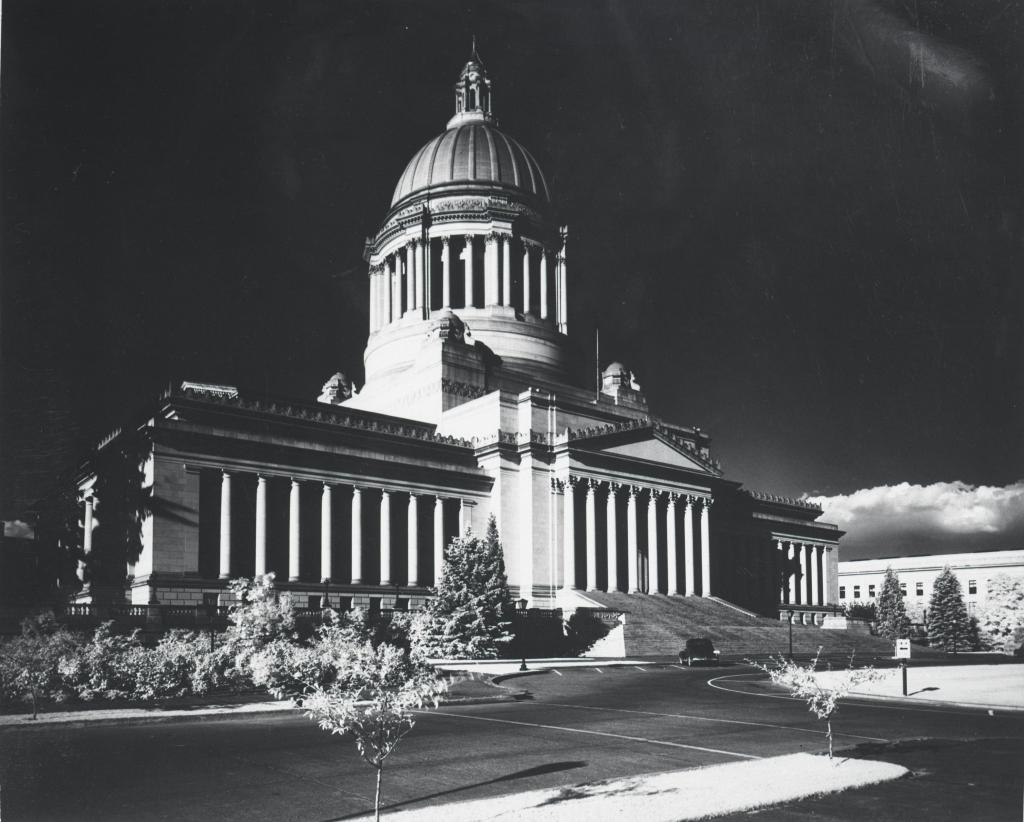
And, while salvage and repair work may not make up the bulk of historic preservation initiatives, this vital work has allowed historically significant structures all over the world to be protected and restored to their full glory in the face of natural and man-made disasters.
So, in celebration of Historic Preservation Month, History Becomes You thanks preservationists and communities all over the world who continue to fight for the protection of historic sites and structures. Your work and efforts have not gone unnoticed and we celebrate you!
If you would like to learn more about Historic Preservation Month, historic preservation, or preservation efforts in your area, you can follow #historicpreservation, #thisplacematters, and #historicproperties on Twitter, Facebook, and Instagram.
Activity #1: Dome and Go Seek
There are many states and regions that have beautiful and historic domed buildings. Can you find any in your area? Don’t know where to start? Try looking at your state capitol building or complex. Domes also play a role in acoustics, so you can also try looking for historical theaters, museums, musical venues, etc.
Happy seeking!
Activity #2: Historic Preservation Near You
Do you know of any historically designated sites or structures near you? For many of us, we have historically significant sites and structures very close to home (for some of you it may even be your home). Can you find three historic sites or structures that have been designated in your area?
Don’t know what to look for? Keep an eye out for historical markers and plaques discussing local, regional, and even national significance. You’ll be surprised to find how much history is in your own back yard!
Did you learn something new about historic preservation? Did you find historic sites and structures in your area? Share your activity results with us on social media by tagging History Becomes You and by using #historybecomesyou!
Check back next week for the next of many peeks into history!
 History Becomes You